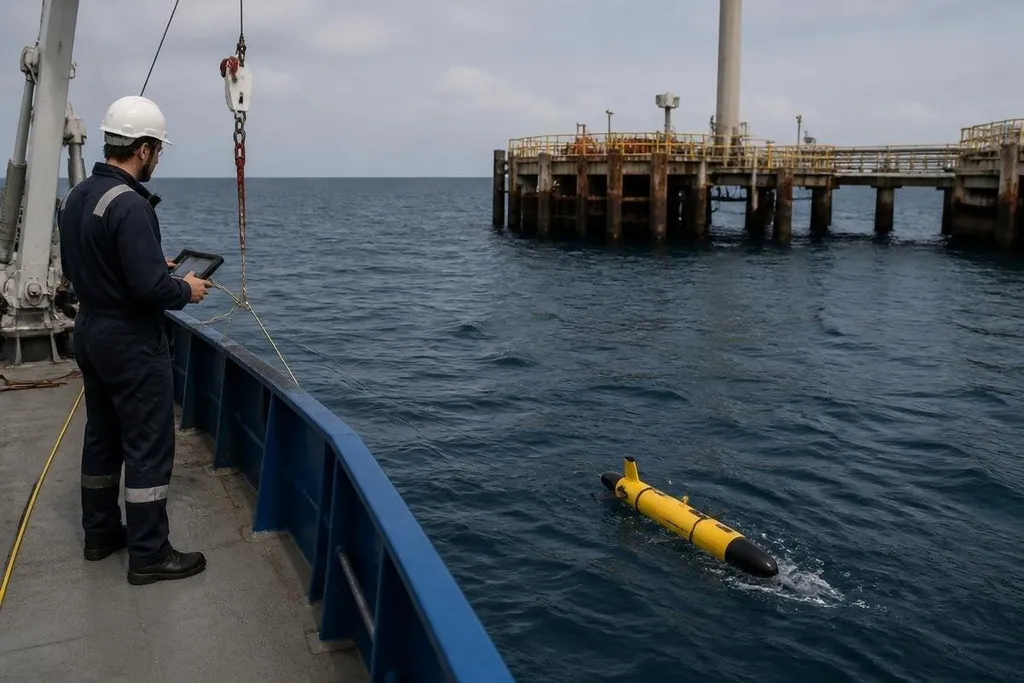
Ships, pipelines, dams, offshore structures, and port equipment all need regular checks below the waterline. Autonomous underwater vehicles can collect images, sonar data, and position records while people stay at the surface, where planning and review are easier.
Quick read
- Autonomous underwater vehicles follow planned routes and record data without a pilot controlling every movement.
- Sonar helps when water is dark, cloudy, or too deep for useful camera images.
- Divers still matter for repairs, close checks, and jobs that need hands on the structure.
How the machines inspect
An autonomous underwater vehicle, or AUV, carries its own battery, computers, sensors, and propulsion system. It follows a route set before launch, then adjusts its movement using data from inertial sensors, depth sensors, cameras, sonar, and acoustic positioning systems.
The sensor mix depends on the inspection. Cameras can record cracks, corrosion, marine growth, or loose parts when the water is clear enough. Sonar sends sound through the water and measures the returning signal, so it can map a surface when light cannot reach it.
That data matters because an inspection needs more than a video file. The system should link each image or sonar reading to a position, depth, and time. Engineers can then compare records from separate inspections and see whether a defect has changed.
A tethered remotely operated vehicle, or ROV, works differently. An operator controls the vehicle from a vessel through a cable that carries power and data. ROVs can stay near a structure for long periods and carry tools, while AUVs can cover a planned area without a cable trailing behind them.
What autonomy changes
Autonomy removes the need for a person to control every turn, depth change, and stop. That can make repeat inspections easier because the route and sensor settings can stay close to the earlier run.
The vehicle still needs a clear plan. It must know where it is, avoid the structure, manage its battery, and return or reach a recovery point. Underwater positioning is harder than satellite navigation because radio signals do not travel well through seawater.
AUVs deal with this by combining several sensor inputs. An inertial system tracks motion, depth sensors measure vertical position, and acoustic systems can estimate distance from equipment placed on a vessel or structure.
Each method has limits, so the vehicle may return with gaps in its route or data that needs a human check.
Underwater inspection fits a wider robotics question: can a machine collect enough evidence for a person to act? Reports at Robot24.com can help you compare that evidence with tests from other inspection jobs. The vehicle may find the fault, but a person still decides whether the data is enough.
Where people still make the call
A machine can spot a shape, line, color change, or surface break. Deciding what that finding means takes engineering judgment and knowledge of the structure. A mark on a pipe may be corrosion, marine growth, a shadow, or a camera artifact.
Poor visibility creates another limit. Sonar can show shape and distance, but its images may be harder to read than a clear camera frame. Strong currents can push the vehicle off its route, while moving water can stir sediment and hide the surface.
The machine also cannot repair a damaged valve, remove a piece of debris, or make a safe access plan for a confined space. An inspection team still needs people to set the task, check the data, and decide what happens after a finding.
I’d treat autonomy as a way to collect better repeatable records, not as a replacement for inspection engineers or skilled divers.
A practical buying and deployment check
Before choosing an underwater inspection system, check these points:
- Inspection target: Decide whether the job needs images, sonar maps, thickness readings, or a tool-carrying vehicle.
- Water conditions: Record depth, current, visibility, temperature, and expected sediment before selecting sensors.
- Position quality: Ask how the vehicle records its route and how the team checks its position after recovery.
- Recovery plan: Set a clear procedure for a lost link, low battery, navigation error, or vehicle that cannot return.
- Data review: Confirm who will label defects, compare repeat runs, and approve the inspection record.
- Human access: Keep divers or ROV support available when the job includes repair, close contact, or uncertain findings.
The strongest case for autonomous underwater inspection is repeat work in places where sending people is slow, costly, or unsafe. Its next test is simple: can each run produce a reliable record that an engineer can act on without guessing what the machine saw?